Alan Knight - Steve Bone's tribute
Posted on 3rd Sep 2026 by David Taylor
_29856340320_o.jpg "3 faces")
As part of the History Society's tribute to 'The Legend' we reproduce Steve Bone's Chapter from the 125 year book on the great man.
At different points of Alan Knight's goalkeeping career, QPR, Fulham, West Ham, Arsenal and Chelsea had chances to sign him. That they did not was down to several factors – among them Knight's loyalty, those clubs' reluctance to take a punt and John Deacon's desire to get more money for him. Instead, Knight's entire professional career was played out with Pompey and everyone connected with Portsmouth Football Club can be ultimately grateful none of those moves happened.
Knight stood out on his own for he made a remarkable 801 appearances for the club, stretching over four decades from 1978 to 2000, a one-club record for a keeper. He played in all four Football League divisions and even had a bench ‘appearance’ in the Premier League in January 2004 as he covered a goalkeeper crisis. For historical reasons only, it is a pity he did not get at least the last five minutes. And his service did not end simply as a player, for he extended his time on the payroll first on the coaching staff and more recently as a club ambassador, a job which, as this book goes to print, he is still mightily proud to do.
Supporters have a scout named Reg Lock to thank for the teenage Knight arriving at Fratton Park in the mid-1970s. Knight, born and raised in Balham, south London, played for London schools and trained with QPR and Fulham, and it was at the Cottagers' training ground where the 13-year-old stopper's parents were approached by Lock and asked if he would like a Pompey trial.
Ray Crawford and Tony Barton, both on the backroom staff, were impressed and offered schoolboy forms at 14. Knight thought QPR and Fulham might respond with their own offers. “I told both clubs I’d been offered schoolboy forms at Portsmouth and both said, ‘good luck – I hope it all works out,’” he recalled.
After two years, apprentice terms were all but a formality at Fratton Park, but West Ham, the team he and his family supported, showed interest. Ron Greenwood and John Lyall tried to sell Knight the idea of an apprenticeship at Upton Park, but he told them he had an obligation to Pompey. They suggested he refuse to clean the boots or sweep the terraces at Fratton – but he was having none of that.
West Ham persisted, but when Crawford heard a deal was likely, he told Pompey to forget it, marching into manager Jimmy Dickinson’s office and vetoing the deal there and then. Knight was quite relieved: “If I’d gone there, I’d probably never have played a game. Mervyn Day was first team keeper and not long after that they signed Phil Parkes,” he said.
As an apprentice, Knight famously got his first-team debut when still 16, at Rotherham – in a 1-0 win, but as Pompey were slipping into Division Four. It was not the start of a regular run, as Peter Mellor arrived and kept Knight’s appearances to a minimum.

In 1979/80, aged 18, he got his chance – then promptly blew it. After a run of games in November and December 1979, after Mellor’s form had faltered, Knight ventured into city nightclub ‘Some Place Else’ on New Year's Eve, albeit only briefly and without having a drink. When he let in three at home to Aldershot the next day and Frank Burrows had got wind of the curfew break, the manager told him he was being dropped. “I learned a harsh lesson from that. I didn’t drink that evening – I was only in there a few minutes – but I shouldn’t have been there,” he admitted.
Promotion to Division Three followed for the club in May 1980 and Knight vividly remembered the Guildhall celebrations, his first real show of what the club meant to the fans. And two more such occasions followed once he had forced his way into the ‘No1’ position, which he did in the summer of 1981. A performance in November 1981, as Pompey ground out a 0-0 draw at Plymouth thanks to Knight’s heroics, marked him out as one to watch.
Knight’s second season as first choice was a triumph, as he and the likes of Alan Biley, Billy Raffety, Steve Aizlewood and Bobby Doyle won the Division Three title. He believed their rise at this time had as much to do with Burrows as with Bobby Campbell, who by then was manager. “The club was a juggernaut that needed turning and Frank did that,” said Knight. “But Bobby came in and took it to another level with the signings he made. It was remarkable.”
Managers and players came and went frequently through Knight’s playing days, as they do, but he was a permanent fixture, to the frustration of understudies like Andy Gosney, who displaced him for a short period in the late 1980s. Knight even made a couple of appearances for England under-21s, including an international debut at Fratton Park in March 1983, as Greece were beaten 2-1.
It was under manager Alan Ball that more success came as Knight, now with the fearsome double act of Noel Blake and Billy Gilbert in front of him in a team that has gone down in Fratton folklore, helped Pompey win promotion back to Division One. Before they did there was a point where his days at the club might have ended. In the 1984/85 season he discovered, via the Daily Star, that Arsenal wanted him. Ball confirmed it – not that anyone had thought to ask Knight what he thought – and sent him home from training to wait for the Gunners to phone. The call never came and it transpired Pompey chairman John Deacon had wanted more than Arsenal were willing to pay. Knight wondered what might have been and later went on the transfer list. But bids never came – and he got on with the job at hand, which was achieved as the side secured a top-flight return in May 1987.
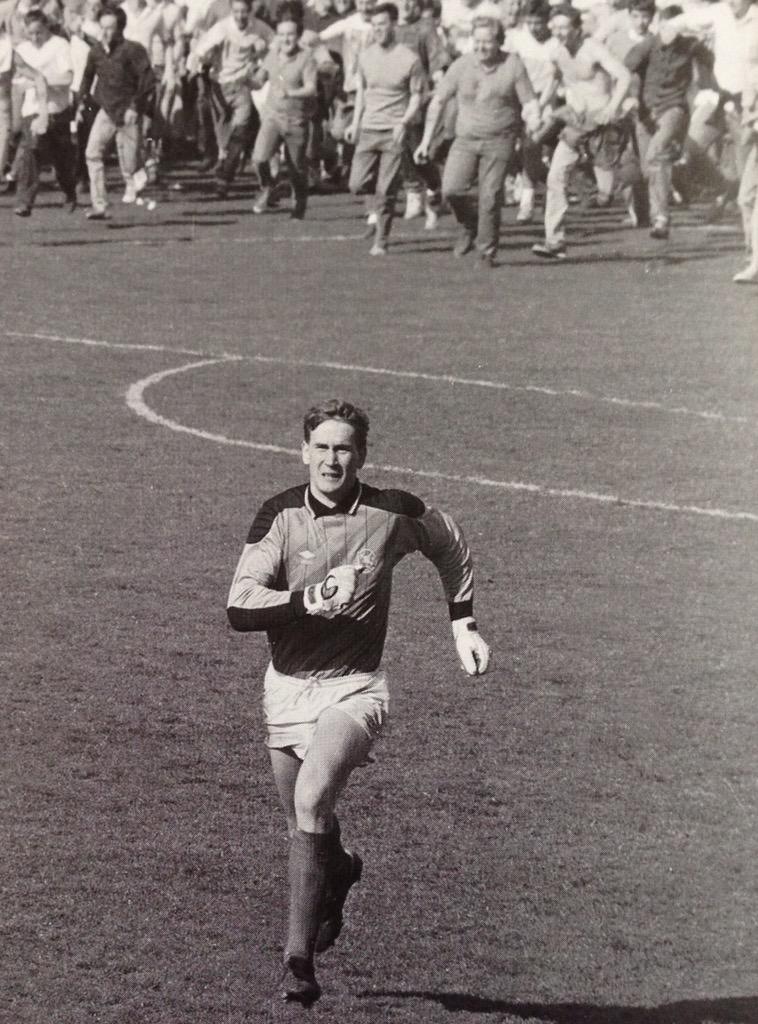
“That promotion team of the 80s was very tight knit; team spirit wise we were very, very close. We used to fight among ourselves, but it was always for the common good,” he reflected.
The 1987/88 campaign ended in relegation, confirmed a fortnight after Knight suffered horrific facial injuries in an aerial assault by Wimbledon at Plough Lane. It was a low point for him and then for the club, as Deacon's lack of investment in the team came home to roost. “Getting my face smashed in at Wimbledon just topped off a nightmare season after all that work to get there,” he rued.
The squad was refreshed, several times in fact, as John Gregory, Burrows again, then Jim Smith tried to bring about a return to the top tier. But Knight was still ‘No1’ as Pompey got within a few minutes or a couple of penalties of the 1992 FA Cup final, then – a year later – within one point, one measly goal of the all-new Premiership.
“The FA Cup run was a fantastic time,” said Knight. “When the semi-final draw was made, we said, ‘we'll have to send the cup final suits back’. We gave everything, but it was all ifs, buts and maybes. And we’d have won the final had we got there. Then the following season, Walshy came in and took us to another level, with Macca and Guy and others. It was very frustrating to miss out in the way we did, losing at Sunderland, then going out to Leicester to that clearly offside goal.”
By now Knight was in his 30s and his position as first choice was challenged, though he was rewarded with a May 1994 testimonial against Southampton, in which he scored a penalty. Smith brought in big Estonian Mart Poom that summer, but Knight rose to the challenge and kept him out of the side. Soon it was the turn of Aaron Flahavan to come through and, at times, manager Terry Fenwick, who had taken over from the Bald Eagle, preferred the youngster, whose career and life was to be tragically cut short in 2001, something that hit Knight hard having become close to his rival.
Knight won two ‘Player of the Season’ gongs in the 1990s and recalls getting on well with Fenwick, but Terry Venables’ arrival at Fratton changed things: “He gave me the old ‘there’s a time that comes when you have to think about retiring or moving on’ talk. I had stuff going on in my personal life and Venables said: ‘I've got my contacts in Australia – I can get you out there.’” Knight was tempted – yet no more was ever said about it.
A loan move to Chelsea might also have come about in the late 1990s. Eddie Niedzwiecki, the assistant to Mark Hughes at Stamford Bridge, phoned and said they had a goalkeeping crisis. Knight liked the idea of being at a Premiership club, even on the bench, but Pompey wanted a loan fee and Chelsea were not going to pay one.
Ball returned as manager in February 1998 and when Knight gave way to Flahavan on a more permanent basis, the boss suggested he should become goalkeeping coach – a relatively new idea in football back then, but one that suited him.
Knight’s 800th game for the club was at Blackburn in 1999 – where home and away fans rose as one to salute him – and his final start in a Pompey shirt came three days into the year 2000, as another keeping crisis brought a call-up for a trip to Norwich. That was not quite his last involvement in a matchday squad, though. A full four years later, he got that Premier League wish, sitting on the bench for Pompey – again short in the ‘between the sticks’ department – at Aston Villa.
“I think Harry Redknapp wanted to use that to show Milan Mandaric he was down to the bare bones,” Knight smiled. “I was never going to get on. Like Harry said, he was running a football club, not a circus! Shaka Hislop was in goal that night and said he might claim he had a hamstring injury and have to come off... luckily he didn’t.”
A while after Redknapp's 2004 departure, Knight felt it was the right time to move on. A desire to get away from personal problems took him to FC Dallas to work with ex-Pompey teammate Colin Clarke. A burst appendix and huge medical bills made it a stressful stay and after Clarke was sacked as manager of the side, he came back to the UK.
That was the start of an eight-year break from Pompey, which also included coaching spells with Havant & Waterlooville, Bournemouth, Aldershot and Dorchester. And in 2008, determined to beat his alcohol problems, he went into rehab at Sporting Chance. “Without being too dramatic, that did save my life,” said Knight. “It turned my life around and I got back into work – ground working up at Heathrow Airport.”
With Pompey on their knees again late in 2012, Guy Whittingham returned as manager and did not have a keeper coach. Knight texted him and said he could do it until the end of the season. “Within two days I was kicking balls at the keepers in the warm-ups at Fratton Park again,” he said.
He quickly realised goalkeeping – and coaching – had changed and he was no longer cut out for it, thinking that would mean a return to ground working. But chairman Iain McInnes and chief executive Mark Catlin offered him a role working alongside Pompey’s community department and promoting the club and projects in the city. The role has developed, but you would still find Knight doing it – and enjoying it. He had also done work for Sporting Chance, ‘giving something back’.
“I'd always want to be involved in this club, in whatever role that may be,” he said. “Maybe I’ll end up sweeping the terraces again!” You could not really imagine Pompey and Knight having nothing to do with each other ever again. All at Fratton Park will be glad of that – and that none of those London clubs ever got their hands on him...